DMC
Delhi Medical Council
DMC-7795
DMC Registration No.

Bank Your Best Quality Embryos
We can store the healthy embryos obtained from your IVF cycle to be transferred later on, used for preimplantation genetic testing, or for future siblings. We use the vitrification method and follow proper storage guidelines to keep your embryos secure. By Dr. Mona Dahiya, with 25+ years of experience.
Families
Years Of Experience
IVF Success Rate
Successful IVF Cycles
Registered Medical Practitioner
Dr. Mona Dahiya is a registered fertility doctor.
DMC-7795
DMC Registration No.
MCI-09/6820
MCI Registration No.
UPMC-110541
UPMC Registration No.
About Embryo Freezing (Cryopreservation)
Reasons why Dr. Mona Dahiya suggests embryo freezing & embryo banking.
Before Embryo Freezing
Some tests may be required to confirm the diagnosis and to find the correct course of action. Each patient has different requirements.
Embryo Freezing (Cryopreservation) Treatment Procedure
Understand the different steps involved. This may vary based on your requirements discussed at the clinic.
Experience and Knowledge
From the clinic
A patient at risk of OHSS had all her embryos vitrified and waited a cycle. The prepared frozen transfer that followed led to a healthy pregnancy.
Details changed to protect patient privacy. Individual results vary.
Embryo Freezing Cost in Delhi, Noida & Ghaziabad
It includes the cost to freeze embryos and yearly storage charges. Frozen embryo transfer would be an additional cost.
Appointments
Dr Mona Dahiya has three clinics that she operates at. She practices in Noida, Ghaziabad and Delhi. We also offer online consultation.

RAJ NAGAR EXTENSION
2nd Floor, RDC, C-53A, near Bikanerwala, Sector 15, Sector 10, Raj Nagar, Ghaziabad, Uttar Pradesh 201002

LAJPAT NAGAR
Building Number 41, First Floor, Ring Road, Block Q, Lajpat Nagar IV, Lajpat Nagar, New Delhi 110024
Frequently Asked Questions
There is no fixed time period. You can store them as long as you want, depending on the law and your wishes.
Frozen embryo transfer has a similar outcome to fresh embryo transfer. Discuss this with your doctor.
It depends upon you. You can store them, donate them to research as per law, or allow them to be disposed of. All of these would require consent.
Studies have shown that vitrified embryos have better health outcomes. Discuss this in more detail with your doctor.
The pregnancy rate from frozen embryo transfer is equal to fresh embryo transfer. The survival rate of embryos after thawing is more than 95–98%. Here are the average pregnancy rates per transfer for each age group:
If you transfer a euploid embryo (confirmed by PGT-A), pregnancy rates are greater than 60% at all ages. Also, the risk of developing OHSS is zero with frozen embryo transfer.
Studies have shown that embryos can be stored indefinitely. Babies have been born from embryos that were frozen for more than 30 years. As per the ART Act 2021, embryos can be stored for up to 10 years, beyond which they will be allowed to perish or can be donated to research.
Freezing embryos gives you a higher success rate and survival rate after thawing. An egg is a single cell with more water content, so its survival rate drops to 85–90%. A blastocyst contains 100–150 cells, with a higher survival rate after thawing (>95%).
There are 3 different costs you need to consider when you decide to store embryos:
Embryo banking involves 2–3 collections to have enough blastocysts to transfer. This helps patients who have a low ovarian reserve, who may produce only 1–2 blastocysts per retrieval. Having 2–3 euploid embryos gives you around a 95% chance of at least one baby. It can also save cost on genetic testing when we send all the samples at once.
Babies born from frozen embryos are as healthy as those born from fresh embryos. There is no evidence that frozen embryos are unsafe. In fact, due to no hormonal effect during implantation, the baby has a 15–20% lower risk of low birth weight.
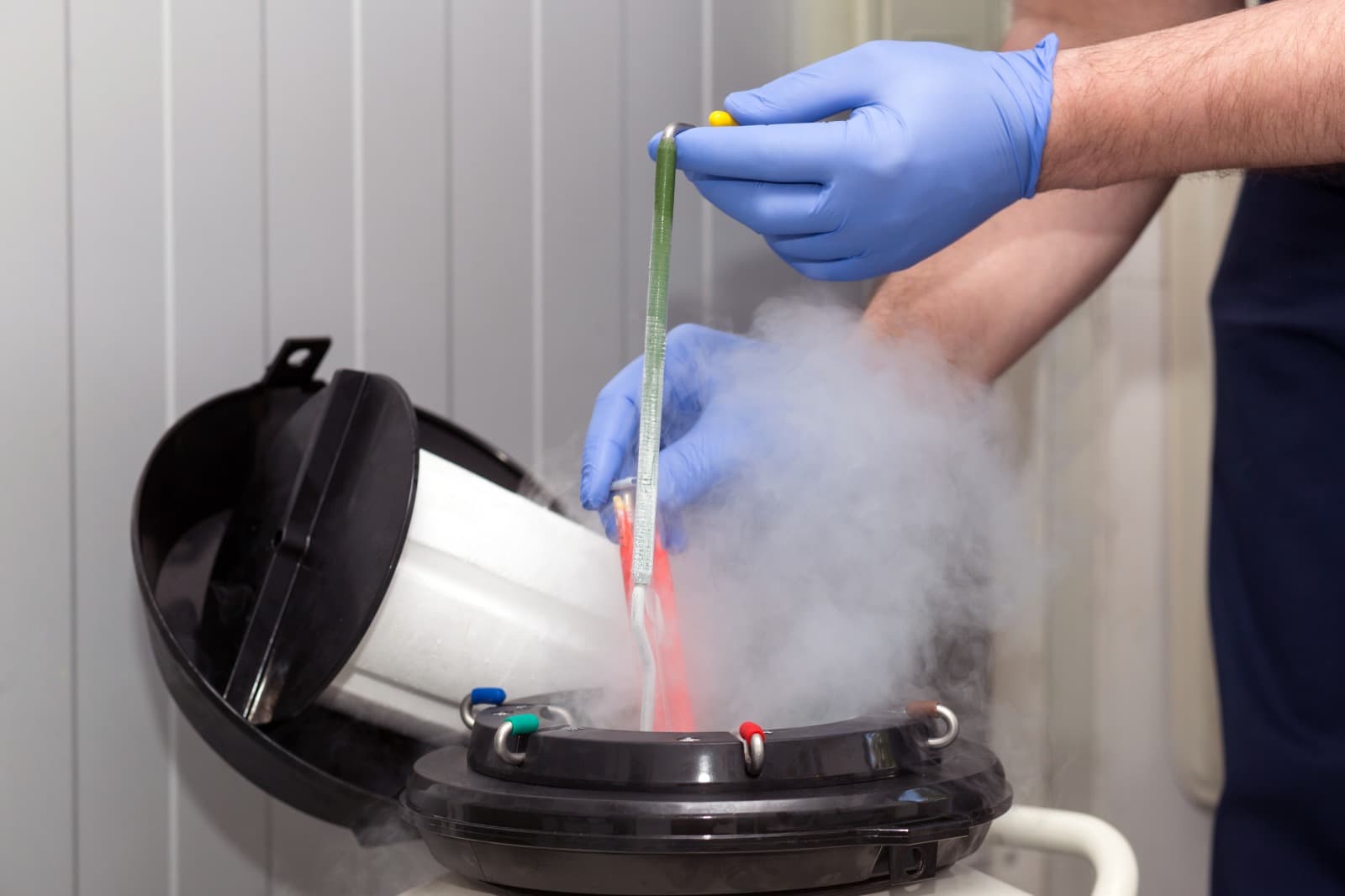
We use a method called vitrification to freeze the embryo. This ensures no ice crystals are formed inside the embryo. Here are the basic steps:
Normally we take a biopsy of the embryo before freezing to test for genetic defects. But if you have frozen embryos without a biopsy, they can be thawed, biopsied and refrozen. Most laboratories have a high survival rate of 85–90% even after double vitrification.
Once you are done having children, you can either continue storing them, allow them to perish, or donate them to research. This depends on your wishes and requires consent forms to be signed.
Vitrification freezes the embryo quickly and reduces harm to less than 3–5% of embryos. When thawed, the blastocyst re-expands its cavity within 2–4 hours, showing that it is viable for transfer.
Related care
Book an in-clinic consultation with Dr. Mona Dahiya in South Delhi, Noida or Ghaziabad, or schedule an online consultation to review your cycle history.
Online consultation
Online consultation